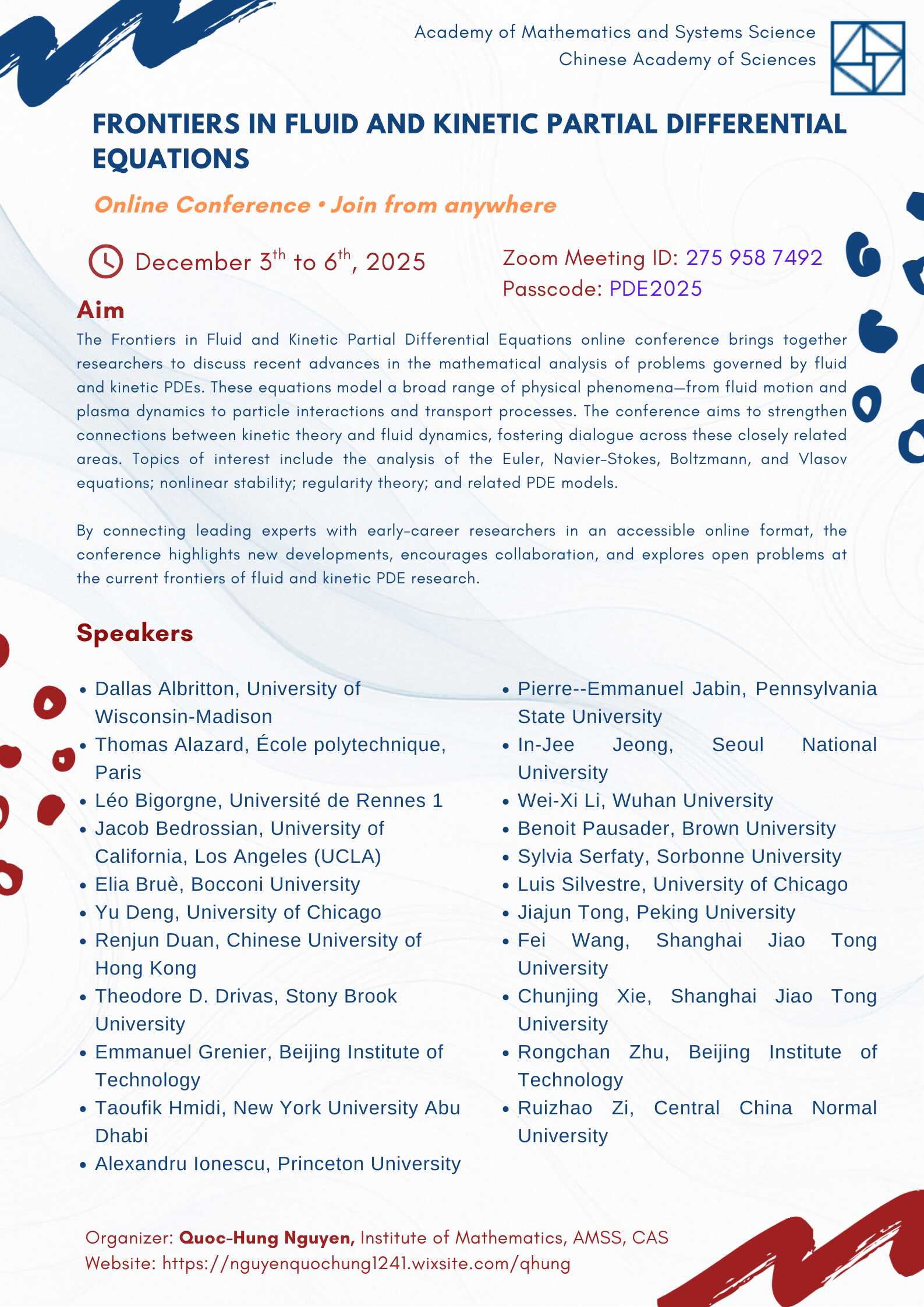
Thomas AlazardÉcole Polytechnique, Paris
Dallas AlbrittonUniversity of Wisconsin–Madison
Jacob BedrossianUCLA
Léo BigorgneUniversité de Rennes 1
Elia BruèBocconi University
Yu DengUniversity of Chicago
Theodore D. DrivasStony Brook University
Renjun DuanChinese University of Hong Kong
Emmanuel GrenierBeijing Institute of Technology
Taoufik HmidiNYU Abu Dhabi
Alexandru IonescuPrinceton University
Pierre-Emmanuel JabinPennsylvania State University
In-Jee JeongSeoul National University
Wei-Xi LiWuhan University
Benoit PausaderBrown University
Sylvia SerfatySorbonne University
Luis SilvestreUniversity of Chicago
Jiajun TongPeking University
Fei WangShanghai Jiao Tong University
Chunjing XieShanghai Jiao Tong University
Rongchan ZhuBeijing Institute of Technology
Ruizhao ZiCentral China Normal University
Abstracts
Speaker: Thomas Alazard (École Polytechnique, Paris)
Title: Nonlinear interpolation and the flow of quasilinear equations
Abstract: I will present an abstract result showing that, for a quasilinear evolution problem, the continuity of the data-to-solution map follows automatically from the estimates that are usually established in the proof of existence of solutions. This is joint work with N. Burq, M. Ifrim, D. Tataru, and C. Zuily.
Speaker: Dallas Albritton (University of Wisconsin–Madison)
Title: Self-similar solutions to the 2D Navier-Stokes equations
Abstract: In 2014, Jia and Sverak constructed self-similar solutions evolving from arbitrarily large scaling-invariant initial data in 3D and conjectured that they go unstable at high Reynolds numbers and thereby generate non-unique solutions. In 2D, Leray-Hopf solutions are unique, but this picture may still hold in the infinite-energy class. We construct self-similar solutions evolving from arbitrarily large scaling-invariant initial data in 2D and present numerical evidence of non-uniqueness. Joint work with Julien Guillod (Sorbonne Universite and ENS), Mikhail Korobkov, and Xiao Ren (Fudan University).
Speaker: Jacob Bedrossian (University of California, Los Angeles)
Title: [Title To Be Announced]
Abstract: [Abstract To Be Announced]
Speaker: Léo Bigorgne (Université de Rennes 1)
Title: Modified scattering for the small data solutions to the Vlasov-Maxwell system
Abstract: We will be interested in the solutions to the Vlasov–Maxwell system arising from sufficiently regular
initial data, with a small distribution function. In particular, we will compare their asymptotic behavior
with that of the solutions to the linearised system. While the electromagnetic field can be approximated by
a linear solution, the distribution function exhibits a modified scattering dynamic: due to the long–range
effects of the Lorentz force, it converges along linear characteristics corrected by a logarithmic term. A
key step in defining these modified characteristics is to identify an effective Lorentz force that governs
the asymptotic behavior of the force field.
Speaker: Elia Bruè (Bocconi University)
Title: Lyapunov Exponents and Mixing in DiPerna-Lions Flows
Abstract: In 2003, Bressan proposed a conjecture on the mixing efficiency of incompressible flows, which remains open.
This talk surveys progress toward resolving Bressan’s mixing conjecture and presents a new result confirming
its asymptotic validity for time-periodic velocity fields. We accomplish this by adapting dynamical systems
tools to the non-smooth framework of DiPerna-Lions flows. Furthermore, we discuss links to bounds on metric
entropy and extensions of the Ruelle inequality.
Speaker: Yu Deng (University of Chicago)
Title: Long time derivation of Boltzmann equation from hard sphere dynamics
Abstract: We present recent works with Zaher Hani and Xiao Ma, in which we derive the Boltzmann equation from the
hard sphere dynamics in the Boltzmann-Grad limit, for the full time range in which the (strong) solution to
the Boltzmann equation exists. This is done in the Euclidean setting in any dimension d ≥ 2, and in the
periodic setting in dimensions d ∈ {2,3}. As a corollary, we also derive the corresponding fluid
equations from the the hard sphere dynamics. This executes the original program, proposed in Hilbert's Sixth
Problem in 1900, pertaining to the derivation of hydrodynamic equations from colliding particle systems, via
the Boltzmann equation as the intermediate step.
Speaker: Theodore D. Drivas (Stony Brook University)
Title: Some results on the long-time behavior of 2D fluids
Abstract: We will discuss some results concerning the long-time behavior of solutions to the two-dimensional
incompressible Euler and Navier-Stokes equations. One at zero viscosity and long times, the other at long
time and subsequently zero viscosity.
Speaker: Renjun Duan (Chinese University of Hong Kong)
Title: Kinetic shear flow via the nonlinear Boltzmann equation
Abstract: In the first part of the talk, we survey recent results on the nonlinear Boltzmann equation for kinetic
shear flow. We discuss the issue in two cases either on the finite interval with finite energy or on the
infinite interval with infinite energy at infinite time. In the second part, we focus on a recent study of
the diffusive limit of the time evolutionary Boltzmann equation in the half space T² × R⁺ for a small
Knudsen number ε > 0. For boundary conditions in the normal direction, it involves diffuse reflection
moving with a tangent velocity proportional to ε on the wall, whereas the far field is described by a global
Maxwellian with zero bulk velocity. The incompressible Navier-Stokes equations, as the corresponding formal
fluid dynamic limit, admit a specific time-dependent shearing solution known as the Rayleigh profile, which
accounts for the effect of the tangentially moving boundary on the flow at rest in the far field. Using the
Hilbert expansion method, for well-prepared initial data we construct the Boltzmann solution around the
Rayleigh profile without initial singularity over any finite time interval.
Speaker: Emmanuel Grenier (Beijing Institute of Technology)
Title: Bifurcations of viscous boundary layers in the half space
Abstract: It is well-established that shear flows are linearly unstable provided the viscosity is small enough, when
the horizontal Fourier wave number lies in some interval, between the so-called lower and upper marginally
stable curves. In this article, we prove that, under a natural spectral assumption, shear flows undergo a
Hopf bifurcation near their upper marginally stable curve. In particular, close to this curve, there exists
space periodic traveling waves solutions of the full incompressible Navier-Stokes equations. For the
linearized operator, the occurrence of an essential spectrum containing the entire negative real axis causes
certain difficulties which must be overcome. Moreover, if this Hopf bifurcation is super-critical, these
time and space periodic solutions are linearly and nonlinearly asymptotically stable. This is a joint work
with D. Bian and G. Iooss.
Speaker: Taoufik Hmidi (New York University Abu Dhabi)
Title: Desingularization of Periodic Orbits in Vortex Dynamics via KAM Theory
Abstract: In this talk, I will present recent advances in the study of vortex dynamics for the two-dimensional Euler
equations. I will discuss results on the desingularization of time-periodic point vortex configurations,
both in rigid and non-rigid frameworks. The focus will be on the rigorous construction of a leapfrogging
motion associated with Love’s four-vortex configuration, obtained through a combination of KAM theory and
the Nash–Moser iterative scheme.
Speaker: Alexandru Ionescu (Princeton University)
Title: On the wave turbulence theory of 2D gravity water waves
Abstract: I will talk about some recent work on the problem of establishing a wave turbulence theory for water waves
systems. This is a classical problem in Mathematical Physics, going back to pioneering work of Hasselmann.
To address it we propose a new mechanism, based on a combination of two main ingredients: (1) deterministic
energy estimates for all solutions that are small in L∞-based norms, and (2) probabilistic
arguments aimed at understanding propagation of randomness on long time intervals. This is joint work with
Yu Deng and Fabio Pusateri.
Speaker: Pierre-Emmanuel Jabin (Pennsylvania State University)
Title: A duality method for mean-field limits with singular interactions
Abstract: We introduce a new approach to derive mean-field limits for first- and second-order particle systems with
singular interactions. It is based on a duality approach combined with the analysis of linearized dual
correlations, and it allows to cover for the first time arbitrary square-integrable interaction forces at
possibly vanishing temperature. The approach also provides convergence rates, and some statistical form of
Central Limit Theorem at the limit. This corresponds to joint works with D. Bresch, M. Duerinckx, and
N. Khoury.
Speaker: In-Jee Jeong (Seoul National University)
Title: Stability of multiple Lamb dipoles
Abstract: Classical variational approach of maximizing the kinetic energy under constraints provides nonlinear
stability of the maximizing vortex configuration in various settings, but this approach fails to handle the
situations where the vorticity is concentrated at multiple points in the fluid domain. This is simply
because such configurations are not even local kinetic energy maximizers, even when we restrict the
admissible class using all known coercive conserved quantities. We present results on nonlinear stability of
superpositions of several Lamb dipoles, obtained by combining classical variational principle with
dynamical bootstrapping schemes. This is based on several joint works with Ken Abe, Kyudong Choi, and
Yao Yao.
Speaker: Wei-Xi Li (Wuhan University)
Title: On the radius of analyticity and Gevrey regularity for the Boltzmann equation
Abstract: This talk studies the non-cutoff Boltzmann equation for hard potentials in a perturbative setting. We first
establish a sharp short-time estimate on the radius of analyticity and Gevrey regularity of mild solutions.
Furthermore, we obtain a global-in-time radius estimate in Gevrey space. The proof combines hypoelliptic
estimates with the macro-micro decomposition.
Speaker: Benoit Pausader (Brown University)
Title: Stability of small BGK waves
Abstract: The BGK waves are the steady states for the 1d Vlasov-Poisson system. We consider their linear stability and derive a simple criterion. This is joint work with D. Bian, E. Grenier and W. Huang.
Speaker: Sylvia Serfaty (Sorbonne University)
Title: Mean-Field Limits and Modulated Energy Methods
Abstract: A central theme in this body of work is the rigorous derivation of mean-field limits for systems of
particles with singular interactions—notably Coulomb and Riesz types. These systems are governed by
gradient flows, conservative flows, and may include stochastic (noisy) effects. The modulated energy method
is introduced as a tool to quantify convergence from a discrete particle system to a continuum PDE limit. At
the heart of this approach lies a commutator-type functional inequality, which has seen significant recent
progress. Global-in-time convergence is also addressed.
Speaker: Luis Silvestre (University of Chicago)
Title: Monotonicity of the Fisher information in kinetic equations
Abstract: We discuss recent results showing that the standard Fisher information is monotone in time
for the space homogeneous Boltzmann and Landau equations. This new Lyapunov functional allows us to
establish the existence of global smooth solutions in all cases that remained open. To prove this monotonicity,
we introduce a novel doubling-variables technique and reduce the problem to an inequality in the family of
the log-Sobolev inequalities.
Speaker: Jiajun Tong (Peking University)
Title: The Immersed Boundary Problem in 2-D: the Navier-Stokes Case
Abstract: We will report recent progress on the 2-D immersed boundary problem with the Navier-Stokes equation, which
models coupled motion of a 1-D closed elastic string and ambient fluid in the entire plane. This is based on
joint works with Dongyi Wei.
Speaker: Fei Wang (Shanghai Jiao Tong University)
Title: Asymptotic Stability of Shear Flows Near Couette with Navier Boundary Condition
Abstract: We consider the 2D, incompressible Navier-Stokes equations near the Couette flow, ω^(NS) = 1 + ε ω,
set on the channel T × [-1, 1], supplemented with Navier boundary conditions on the perturbation,
ω|_{y = ±1} = 0. We are simultaneously interested in two asymptotic regimes that are classical in
hydrodynamic stability: the long time, t → ∞, stability of background shear flows, and the inviscid
limit, ν → 0 in the presence of boundaries. Given small (ε ≪ 1, but independent of ν) Gevrey 2-datum,
ω₀^(ν)(x, y), that is supported away from the boundaries y = ±1. This is the first nonlinear
asymptotic stability result of its type, which combines three important physical phenomena at the nonlinear
level: inviscid damping, enhanced dissipation, and long-time inviscid limit in the presence of boundaries.
Speaker: Chunjing Xie (Shanghai Jiao Tong University)
Title: Rigidity for steady incompressible Euler system and its applications
Abstract: When the steady flows are away from stagnation, the associated Euler equations can be locally reduced to a
semilinear equation. On the other hand, stagnation of flows is not only an interesting phenomenon in fluid
mechanics, but also plays a significant role in understanding many important properties of fluid equations.
It also induces many challenging problems in analysis. First, we discuss the scenario when the Euler
equations can be reduced to a single semilinear equation in terms of stream function. Second, we give a
classification of incompressible Euler flows via the set of flow angles. Finally, the applications for
vanishing viscosity limit of fluid via these classifications will be addressed.
Speaker: Rongchan Zhu (Beijing Institute of Technology)
Title: Φ⁴₃ Theory from many-body quantum Gibbs states
Abstract: We derive the Φ⁴₃ measure on the torus as a rigorous limit of the quantum Gibbs state of an
interacting Bose gas, where the limiting classical measure describes the critical behavior of the Bose gas
just above the Bose–Einstein phase transition. Since the quantum problem is typically formulated using a
nonlocal interaction potential, a key challenge is to approximate the local Φ⁴₃ theory by a Hartree
measure with a nonlocal interaction. This requires uniform estimates on the Hartree measure, which are
achieved using techniques from recent development on stochastic quantization and paracontrolled calculus.
The connection to the quantum problem is then established by applying the variational approach and deriving
a quantitative convergence of the quantum correlation functions to those of the Hartree classical field.
Speaker: Ruizhao Zi (Central China Normal University)
Title: Stability of Couette flow in Stokes-transport equations
Abstract: In this talk, I will present some recent stability results on 2D and 3D Stokes-transport equations around the
Couette with non-homogeneous density background. This is based on joint works with Daniel Sinambela and
Weiren Zhao.